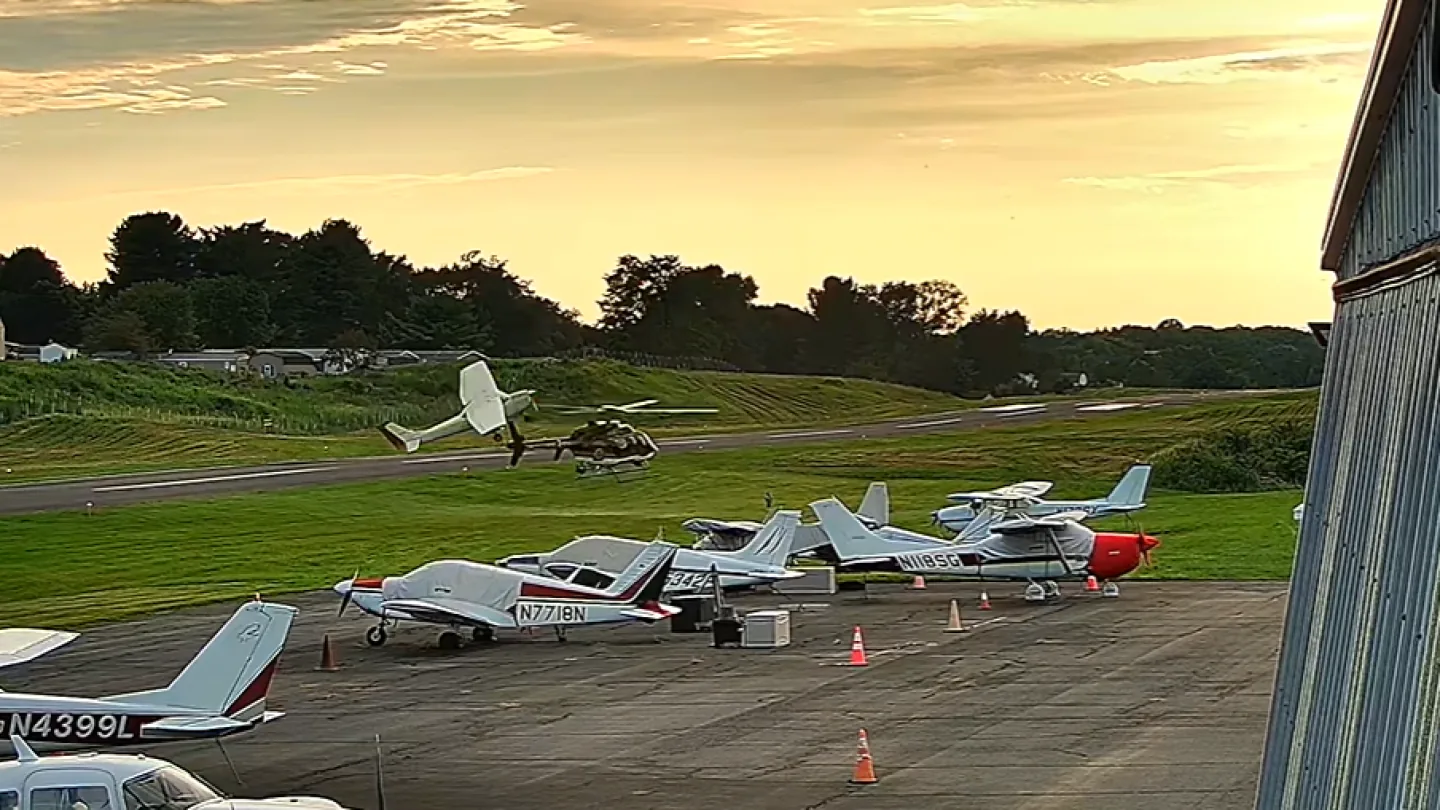
CARLISLE, PA — Newly released video captures the deadly crash between a small plane and a Pennsylvania State Police helicopter that killed the Cessna’s pilot on Aug. 19 near Carlisle.
The footage, obtained by PennLive and described by WHTM, shows the helicopter hovering just feet above the ground as the plane came in to land. As the Cessna descended toward the runway, it veered sharply and struck the helicopter.
Dr. Paul Sokoloski was flying the Cessna and died in the collision. He had been conducting training exercises before the crash, according to WHTM.
How the crash unfolded on approach to the runway
The video gives the clearest public look yet at the moments before impact. In the footage, the helicopter appears to be holding a low position near the ground while the Cessna continues its landing approach.
Then, just before touchdown, the airplane turns abruptly and collides with the helicopter. The crash happened as the aircraft were operating in the same area near the runway, leaving little margin for error once the plane changed course.
That sequence is central to the continuing investigation into what led to the deadly impact. Officials have not said what caused the sudden movement, but the visual record shows how quickly the situation turned catastrophic.
What investigators have said about radio contact and visibility
The National Transportation Safety Board has said the pilots were in communication before the crash. Even so, investigators determined the helicopter crew could not see the plane coming because of their position and orientation at the time.
That finding suggests the crews were aware of one another’s presence, but not necessarily able to visually track the aircraft as the final seconds unfolded. The visibility issue is now one of the key facts shaping the investigation.
NTSB officials have not announced a final cause, and the matter remains open. The agencies involved are still piecing together how the aircraft ended up in the same place at the same time.
Initial NTSB findings show no pre-impact mechanical failure
Early findings from the NTSB indicate investigators found no evidence of pre-impact mechanical failures in either aircraft. That means the helicopter and the Cessna were not showing signs of a mechanical breakdown before the collision, based on the initial review.
Those findings do not close the case. Instead, they narrow the focus to operational factors, aircraft positioning, communication, and the moments immediately before impact.
PennLive reported the initial report and the absence of mechanical failure evidence as investigators continued their work. The crash is still being examined, and no final determination has been released.
The Cessna pilot who died was training before the crash
Dr. Paul Sokoloski was the only person killed in the incident. WHTM reported that he was performing training exercises in the plane when the collision occurred.
That detail adds another layer to the tragedy, because the flight was not a routine passenger trip but a training operation. The collision cut that exercise short in a matter of seconds.
No additional details about Sokoloski’s training or flight plan were provided in the information released with the video. Authorities have not publicly said anything further about the conditions inside the aircraft before impact.
Helicopter crew members have been released from the hospital
The two Pennsylvania State Police helicopter pilots survived the crash and have since been discharged from the hospital. They were identified as Cpl. Bryce J. Corman and Trooper Jason Mills.
Their release marks an important update in a case that could have become even more deadly. While the helicopter crew lived through the collision, the incident still left one pilot dead and investigators searching for a full explanation.
With the NTSB inquiry still ongoing, the released video is likely to remain a key piece of public evidence. It shows how a routine landing sequence turned into a fatal midair collision near the runway.
Local news that matters, from Dulaney Griffin.