MIAMI, FL — Flight data released by investigators suggest an Amazon cargo plane made a late attempt to abort an unsteady landing at Miami International Airport before it slammed into a van and killed five people inside. The National Transportation Safety Board said the Boeing 767 overran the runway Sunday after landing in stormy weather and then struck vehicles beyond the pavement.
The crash also injured five others and left debris scattered across the end of the runway and nearby road. NTSB Chairwoman Jennifer Homendy said investigators are examining flight data, cockpit recordings and other evidence to understand what happened in the final seconds before impact.
Investigators focus on the final seconds before impact
The NTSB plans to interview the pilot and co-pilot on Wednesday as part of the early phase of the investigation. Homendy said the agency wants to speak with the crew before releasing any cockpit voice recorder information about why the aircraft appeared to briefly consider a go-around, then shifted back to trying to stop on the runway.
Homendy said flight data showed the jet’s thrust reversers were never deployed, even though they are used to help slow aircraft after touchdown. The plane landed nose-first and on its right landing gear, a detail former FAA official Mike O’Donnell said points to an unstable landing. He said a go-around should likely have happened earlier.
Runway overrun sent the jet into airport vehicles and a city street
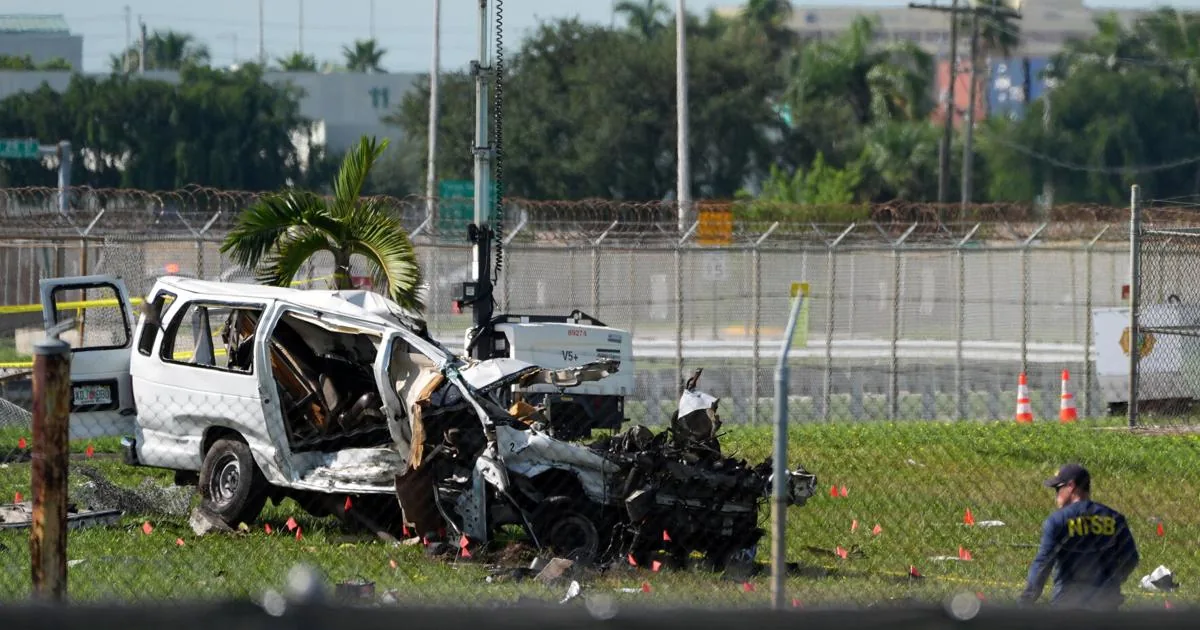
According to the NTSB, the aircraft traveled roughly 1,300 feet past the end of the runway before smashing into a van on airport property, breaking through a fence and then striking an SUV on a nearby city street. The wreckage remained visible Tuesday, including the mangled white van and the badly damaged SUV.
The jet came to rest nose-down with a large soot mark near the word “Prime Air” on the fuselage. Officials said the van belonged to a crew that cleans planes, and all five people killed were inside it when the cargo jet left the runway.
Victims were airport workers in a cleaning van
The Miami-Dade sheriff identified the five people who died as Rolando Aleman Leon, 55; Yoel Rodriguez Naranjo, 53; Julio C. Pineda, 75; Carlos Acosta Fajardo, 53; and Javierkys Reyes Quevedo, 47. The van was owned by Professional Ocean Service Corp., a company that provides aircraft cleaning services.
The company said its employees are like family and asked for privacy and respect for the victims’ loved ones. Amazon said in a statement that it is cooperating with investigators and extended sympathies to the families affected by the crash.
Weather, runway layout and airport safety features are under review
Investigators are also looking at whether weather played a role. The flight had come from Puerto Rico on a two-hour trip as storms built around Miami, and experts said a strong tail wind may have pushed the aircraft far beyond the intended landing point.
Another question is whether the airport should have had a special runway-end system that can slow or stop an aircraft that overruns the pavement. Miami is not among the more than 120 U.S. airports with that lightweight crushable material, though officials say the airport meets FAA requirements for a cleared buffer zone beyond the runway.
Airport operations begin to recover as evidence collection continues
Miami International Airport regained use of a third runway Tuesday evening after investigators released it, even as crews continued documenting the crash site. Airport officials said more than 225 flights were canceled Sunday and Monday, and hundreds more were delayed because of the disruption.
The airport can now use three of its four runways, which should ease the backlog. Homendy said the NTSB will try to turn the runway back to the airport as quickly as possible after the evidence is documented, but the full accident report will likely take a year or more to complete.
The cargo jet had a long history before Amazon service
The aircraft was operated by 21 Air, a North Carolina-based cargo carrier, and was 32 years old. Flight-tracking information showed the Boeing 767 was originally built for passenger service, then flew for several airlines in foreign countries for more than two decades before being converted to a cargo plane in 2015.
Homendy said the crash highlights the dangers runway excursions pose to airport workers and others near active airfields. She said the NTSB’s job is to determine the cause and recommend changes aimed at preventing another tragedy like this one.
Local news that matters, from Dulaney Griffin.